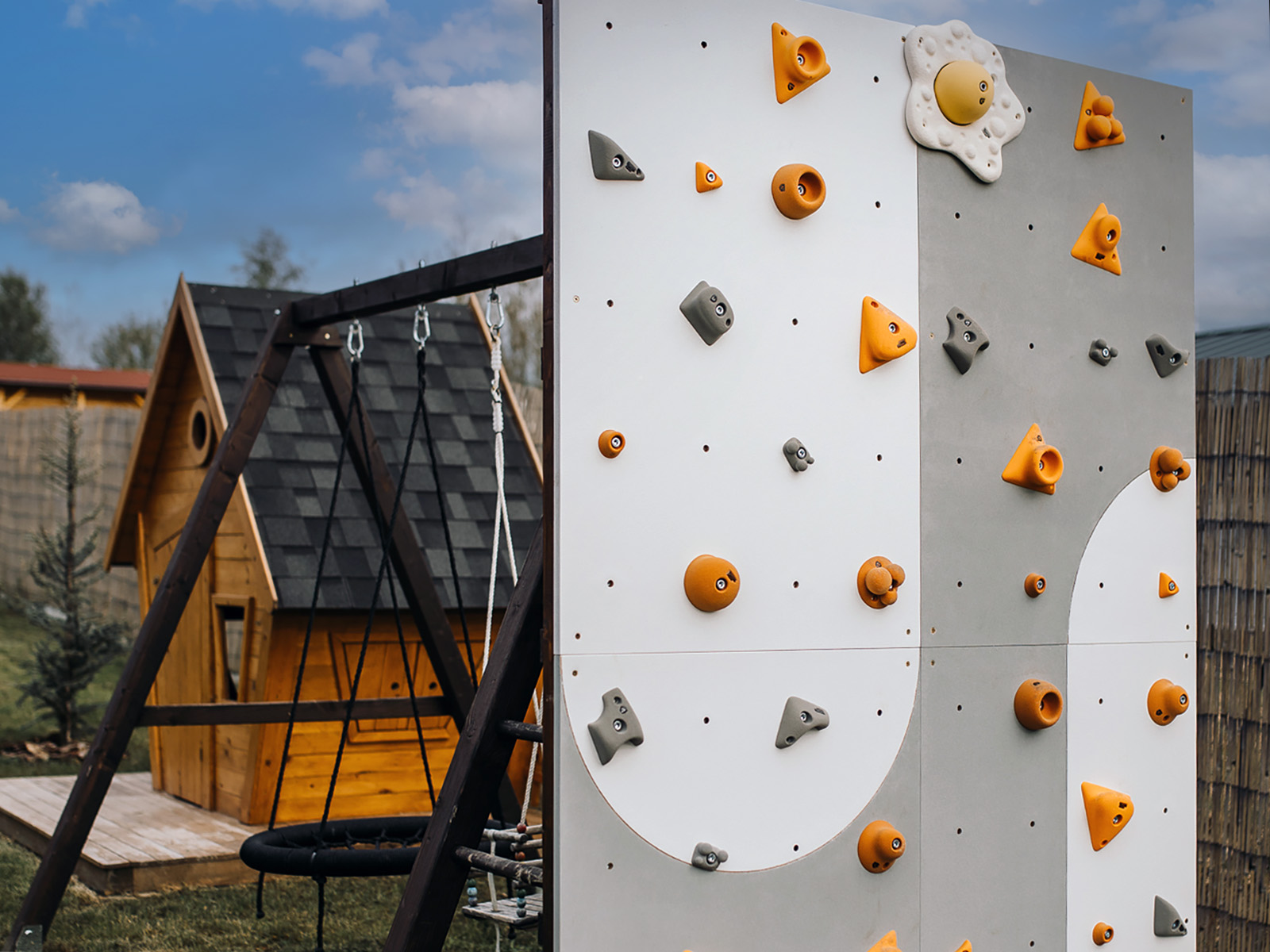
Absolutely – children will definitely love it. But safety rules must be followed. Combining these elements brings together healthy movement with the joy of swinging. While an outdoor climbing wall develops strength and coordination, a garden swing gives children a chance to relax and have effortless fun. To make sure this combination brings only joy and no bruises, you need to plan the correct distances. Safety is not just theory – it is a fundamental principle of every BLOCKids setup.
From a safety perspective, a swing is a specific type of play element. Unlike climbing, where a child moves consciously and under their own power, swinging is a fast, forced movement that the child cannot immediately control because considerable inertia is involved.
The solution is to consistently separate the two activity areas with clear open space where nothing is in the way, while also providing a soft impact surface.
According to EN 1176, which we recommend following at home as well for maximum peace of mind, the zones of play elements with forced movement (including swings) must never overlap with other play elements.
Children caught up in play do not pay attention to everything around them. Their safety therefore depends on the correct layout of the elements so that the swing path and climbing area do not cross.
An impact area is not the same as a safety zone. While a safety zone is a space free of obstacles, an impact area is a surface designed to absorb the energy of a fall. Its parameters are determined by EN 1177 based on the so-called critical fall height.
When choosing a swing, you may be deciding between a classic seat and the nest swing that children love.
If you have a smaller garden, a classic swing allows you to position the climbing wall closer (while still respecting the required zones). A nest swing, on the other hand, is a great relaxation feature if you have enough dedicated “clear space” for it.
1. Can the safety zones of a swing and climbing wall overlap?
No. For play elements that create forced movement, including a garden swing, the safety zones must never overlap with other play equipment. This is an essential condition for preventing a swinging child from colliding with a child climbing on the wall.
2. What is the minimum safe distance between a swing and a climbing wall?
The standard swing zone is 2 metres in front and behind. For the climbing wall, allow 1.5 to 2 metres of clear space. The wall should stand completely outside the swing’s path of movement, ideally at a distance corresponding to the sum of these zones.
3. Is grass sufficient as an impact surface?
Only for lower traverse walls. Grass is acceptable as an impact-absorbing surface only for fall heights up to 1 metre. Even then, it must be maintained and restored if frequent use wears the grass down to hard, compacted soil. For higher setups or elements with dynamic movement (for example, a nest swing with a fall height of up to 1.5 m), choose more effective impact absorption such as sand or certified mats.
4. Does a nest swing require more space than a classic swing?
Yes. A nest swing has a larger diameter and a wider safety zone, which can reach dimensions of up to 3 × 7.5 metres.
5. Can a climbing wall and swing be installed on the same structure?
Yes, but when combining both elements into one setup, you must ensure that the structure can withstand dynamic loads. When a child is moving, the forces acting on both the wall and the swing are much greater than the child’s static body weight alone. If you build the setup as a DIY project, full responsibility for load-bearing capacity and safety rests with you.
6. Do I have to comply with EN 1176 standards in a private garden?
From a legal perspective, this is not mandatory. However, if you want to provide the highest possible level of safety for your children, we recommend following these rules at home as well.
Combining a garden swing and a climbing wall is a great way to create a complete play setup for children, but it requires careful safety planning so that the two activity areas do not “collide”. We will be happy to help you configure the setup so that it meets all the requirements for safe play.

Czech manufacturer of children's climbing walls, holds, and crash pads. We design and manufacture indoor climbing walls in the Czech Republic, meeting EN 1176/1177 safety standards and helping children develop motor skills, strength, and confidence — at home on a children's climbing wall, in the garden, and in kindergartens and schools. We also supply climbing holds for kids and safe crash pads for our walls. We write about what we know from experience: safe climbing for children from wall design to installation.
Design your own climbing wall exactly according to your family’s space, taste, and needs.
Get the kids involved and design a wall together according to your preferences — colors, shapes, and dimensions. Fun designing, beautiful and functional results.

Write to us – we will be happy to recommend a suitable solution and answer your questions.


