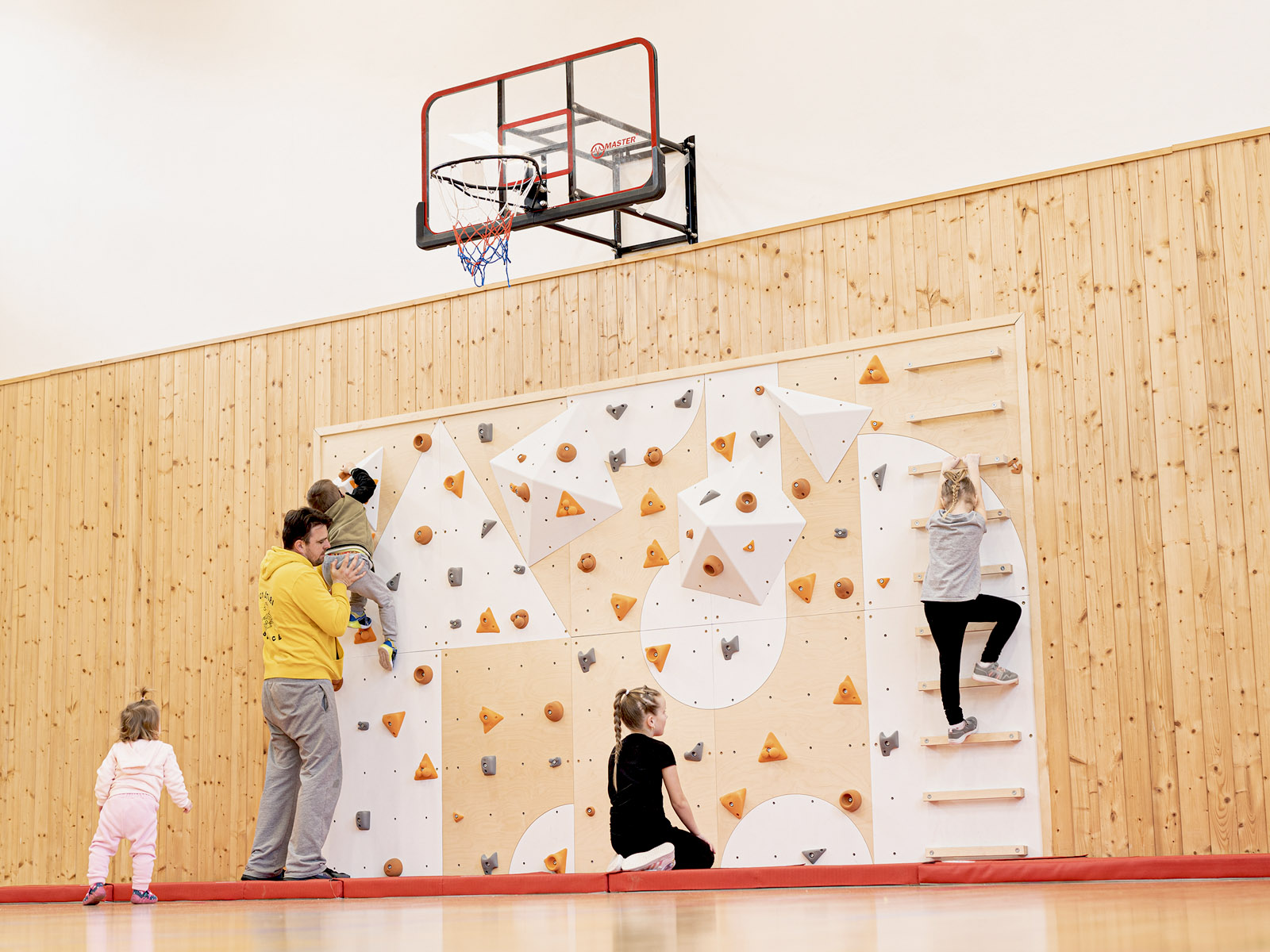
Why Climbing – and What Is Suitable at Each Age
Almost every child wants to climb up high, and as parents we do not always feel comfortable watching it. Yet climbing is completely natural for children. Toddlers start exploring it at a very early age. So let’s create an environment where they can do it safely – a place where children are happy and we do not have to worry about them.
Climbing on a home wall is one of the most effective ways to stimulate a child’s balance system and develop proprioception (awareness of the position and movement of their own body). It strengthens the deep stabilising muscles while also building healthy self-confidence.
When choosing the ideal BLOCKids setup, we do not look only at the size of the room. Above all, we need to understand the child’s changing developmental needs. A well-chosen wall respects both the available space and the specific characteristics of a child’s physiology at each age.
Ages 3-5: Little Explorers
Before starting school, children mainly develop their gross motor skills – naturally and unconsciously through play. At this age, it is not about sporting performance at all; it is mainly about the joy of discovering the world “above the floor”.
- Age-specific needs: Young children are still discovering their own balance and centre of gravity, which is positioned higher than in adults. Not every attempt will work out. Always follow the “within arm’s reach” rule – stay alert and close enough to help immediately.
- Suitable setup: An ideal wall height is 120-150 cm, meaning one panel vertically or a maximum of two panels above each other in landscape orientation. Teach children to traverse (climb sideways close to the ground). If you feel like experimenting, you can also install a BLOCKids panel at a slight angle (for example against a bed frame), making the first climbs easier for little explorers.
- Climbing holds: Choose only large, ergonomic shapes (jugs), for example from brands such as Lama or Therex (animals, cars), and place them close together so children can reach them easily. For maximum comfort for small hands, we recommend special climbing hold sets with a gentler texture.
- Play ideas: Motivate children with games such as “Rescue the Teddy” or “Colour Challenges” (the child tries to reach a toy or may only use holds of a certain colour). If a younger child wants to copy an older sibling, let them try – but keep them under constant supervision.
Ages 6-9: Schoolchildren in Action
Once children start school, climbing becomes a “vertical challenge”. They begin experimenting with bouldering – strategically planning routes without a rope above a safe landing area.
- Age-specific needs: Logical thinking and the ability to coordinate sequences of movements develop rapidly. The wall becomes a tool for practising patience and problem-solving.
- Wall structure: We recommend setups made from several BLOCKids panels, allowing children to combine upward climbing with technical traverses.
- Climbing holds: Use a combination of larger jugs and smaller footholds. This encourages school-age children to think about footwork rather than solving everything with arm strength alone.
Ages 10+: Young Athletes
For teenagers, the wall becomes a fully fledged piece of sports equipment for developing strength, endurance and coordination.
- Age-specific needs: The focus shifts towards sport bouldering. Teenagers will also appreciate an attractive design that fits a modern room.
- A Home “Gym”: Thanks to premium birch plywood with high load-bearing capacity, a BLOCKids wall is a good investment for the whole family. You can even test your strength alongside your teenage children.
- Climbing holds: For more advanced training, we recommend technical crimps and slopers from VirginGrip. They simulate features found on real rock and allow climbers to practise different types of grip.
How Does a BLOCKids Wall Grow with Your Child?
Modularity is at the heart of our system. Rectangular and triangular panels can be connected, expanded and rearranged into different configurations.
- Easy difficulty adjustment:
Our panels are fitted with T-nuts that do not rotate or fall out and create a dense mounting grid across the wall. Moving the holds takes only a few minutes. By changing how many holds you use and how far apart you place them, you can easily adapt the wall to your child’s age and needs (more holds placed close together for younger children; fewer holds with larger gaps for older children).
- A complete play corner: You can add accessories such as the Haptic Balance Bridge, SoftBLOCKS (foam blocks) or a blackboard to support fine motor skills. Most accessories can be used for many different activities, which you can also adapt to the child’s age.
Safety and Technical Standards
For us at BLOCKids, safety is not just a marketing slogan – it is a commitment backed by certification.
- Safety zones: There should be a clear zone of 1.5-2 metres around the wall. This means no obstacles in this area – radiators, sharp furniture corners, toys left on the floor, etc.
- Landing surfaces: Never let children climb above a hard floor. Ideally, use a BLOCKids impact mat that meets strict safety standards. The individual play elements comply with EN 1176 for public and private use.
- Terminology: Distinguish between the informal term “climbing rocks” and the correct terms climbing holds (for hands) and footholds (for feet). Using the correct terminology makes it easier to choose quality equipment.
DIY Installation or Professional Installation?
The BLOCKids system is designed so that any reasonably handy parent can install it in one afternoon using only basic tools. For schools and public institutions where professional turnkey installation and an inspection report are required, we offer installation by our specialists. You can find more information in our article about DIY climbing wall installation.
Frequently Asked Questions
- At what age can a child start climbing? As soon as they can walk steadily (usually around 12-18 months), they can begin trying their first climbing movements under supervision, just above a safety mat.
- Can the panels also be installed on plasterboard? Fixing directly to plasterboard requires special anchors, and the first row of panels must rest directly on the floor (with the wall starting at floor level). If you have reinforced plasterboard partitions or a double layer of plasterboard, there is usually no reason for concern. If you are unsure, consult our specialists.
- What footwear is best? Barefoot climbing is ideal (or soft slippers for very young children) because it gives the feet maximum sensitivity. Hard trainers reduce the feel of the footholds. Older children can use climbing shoes designed specifically for climbing walls.
- How many holds per square metre? We normally recommend 6-10 holds for a balanced and varied climbing route.
- How long does an indoor climbing wall last? With proper maintenance, the lifespan of birch plywood is practically unlimited.
Investing in a home climbing wall is an investment in your children’s health, courage and happiness. With the BLOCKids system, you get a certified solution that can grow with your child for many years.
Do you have questions about the technical solution? Contact us using the form or call us on +420 778 486 745