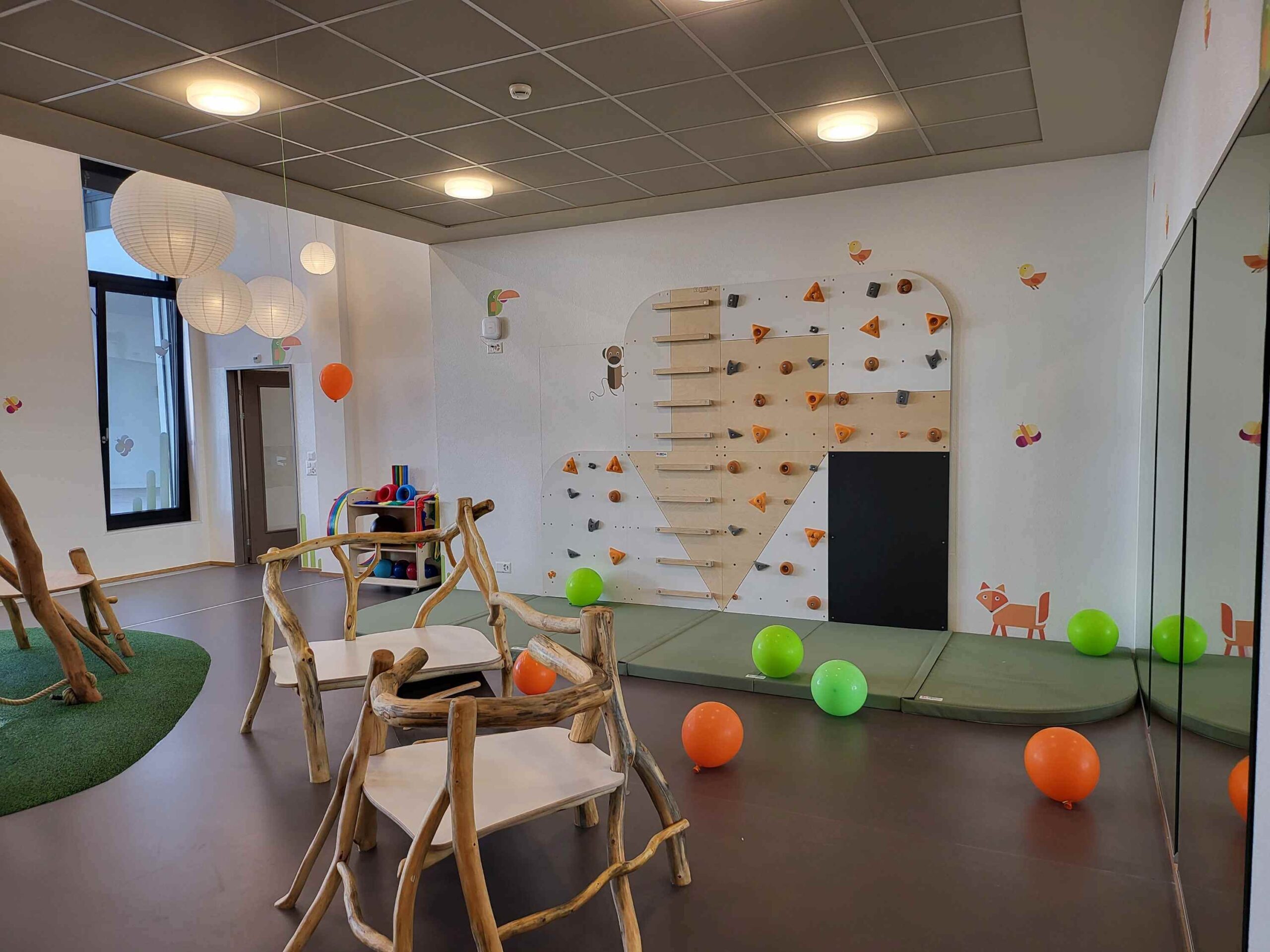
Having your own climbing space at home is a dream for many active children and parents. Home bouldering is booming – it is a great way to get children away from screens, move the whole body, work on coordination and build healthy self-confidence.
Once you decide to give your children this kind of fun, you face a fundamental question: Should you build the wall yourself as a DIY project, or choose a ready-made certified system?
The internet is full of guides on how to build a home climbing wall, and it can be an ideal weekend project for anyone who is reasonably handy. A few boards, a drill, a supply of suitable climbing holds – and you are done. But reality can sometimes be more complicated.
Let’s take a detailed look at both options. We will break down the real costs, the time involved and the hidden risks so that you can make the right and safe decision.
When we hear “DIY climbing wall”, we imagine a low-cost project in which everything is firmly in our own hands. At the other end of the spectrum are turnkey home climbing walls, while somewhere in between are our BLOCKids systems, whose modular panels you can install yourself in just a few hours. Let’s compare all the solutions side by side.
| Feature | DIY wall | Ready-made modular system (BLOCKids) | Turnkey solution |
| Financial investment | Lower (you only pay for materials) | Higher (you pay for a finished, certified product) | Highest (finished product including installation) |
| Time required | High (dozens of hours of planning, shopping, cutting and drilling) | Minimal (installation takes one afternoon) | Minimal (you do not need to deal with anything apart from providing access to your home) |
| Tools required | Advanced (saw, sander, drill, special drill bits, Allen keys) | Basic (drill/screwdriver for anchoring to the wall) | None (the technicians bring all their own tools) |
| Safety and certification | No guarantee (you bear full responsibility yourself) | Full product responsibility (certified for children according to EN 1176) | Contractual (responsibility lies with the installation team) |
| Appearance and interior design | Often industrial, “garage-style” appearance (OSB boards) | Aesthetic design feature (suitable directly for a child’s bedroom) | Design feature depending on the manufacturer (can vary considerably) |
| Possibility of moving/resale | Very difficult (the structure is usually permanently connected to the building) | Easy to dismantle, expand or resell | Depends on the type of wall and manufacturer |
The most common motivation for building a climbing structure yourself is the desire to save money. But is the saving really that significant once you count absolutely everything?
When you look at material prices, you will find that quality plywood and dozens of T-nuts cost money. Add the cost of transporting large boards if you do not have a nearby shop that offers free delivery within a few kilometres.
And now the most important thing – your time. Before a functional wall is ready, you need to design and calculate the load capacity of the structure, measure and drill a grid of holes (ideally 15×15 cm – easily more than 50 holes per panel) and manually hammer the T-nuts into the back of the board (if they do not go in straight, you may not be able to screw the hold in at all, or it may wobble). Finally, you need to finish the surface of the board (sanding, varnishing, or possibly applying a coating mixed with sand for better friction).
As people in online climbing communities often confirm, a DIY home wall is worthwhile mainly if you enjoy the work itself and treat it as a hobby. If you convert your time into an hourly wage, you may find that a ready-made solution in the form of BLOCKids indoor climbing walls costs very much the same overall – if not less.
The individual panels already have a grid for handholds and footholds as well as a professional surface finish, and with the instructions the entire installation is quick and straightforward.
If you build a wall for yourself in the garage and something goes wrong, you may end up with a bump or a bruise. But if you are building a wall for children in their bedroom, you must not underestimate safety.
With a DIY build, all responsibility lies with you.
You need to correctly assess the load-bearing capacity of the wall (brick, drywall, concrete) and choose suitable anchoring. Remember that during a child’s dynamic movement, the wall is subjected not only to the static weight of the child’s body, but to much greater forces that can pull the structure away from the wall.
Ready-made BLOCKids systems are designed and tested specifically for children. They comply with the strict EN 1176 safety standard, giving you confidence that the structure will remain secure even during energetic children’s play. You can learn more about choosing safe components in our article How to Choose a Kids Climbing Wall for a Bedroom.
Do not forget the area beneath the wall either. Whether you choose DIY or a ready-made system, there must always be a high-quality landing area under the wall. The mat should extend beyond the climbing wall on both sides and provide sufficient space in front of it as well.
One of the biggest challenges of a home-built wall is the wall surface itself and the choice of climbing holds. Some people choose OSB boards. This is a cheap solution, but it has a significant disadvantage. Even after thorough sanding and varnishing, there is still a risk that a child may get an unpleasant splinter under the skin when a hand slides along the wall. In addition, the structure of OSB tends to crumble over time under the pressure of T-nuts.
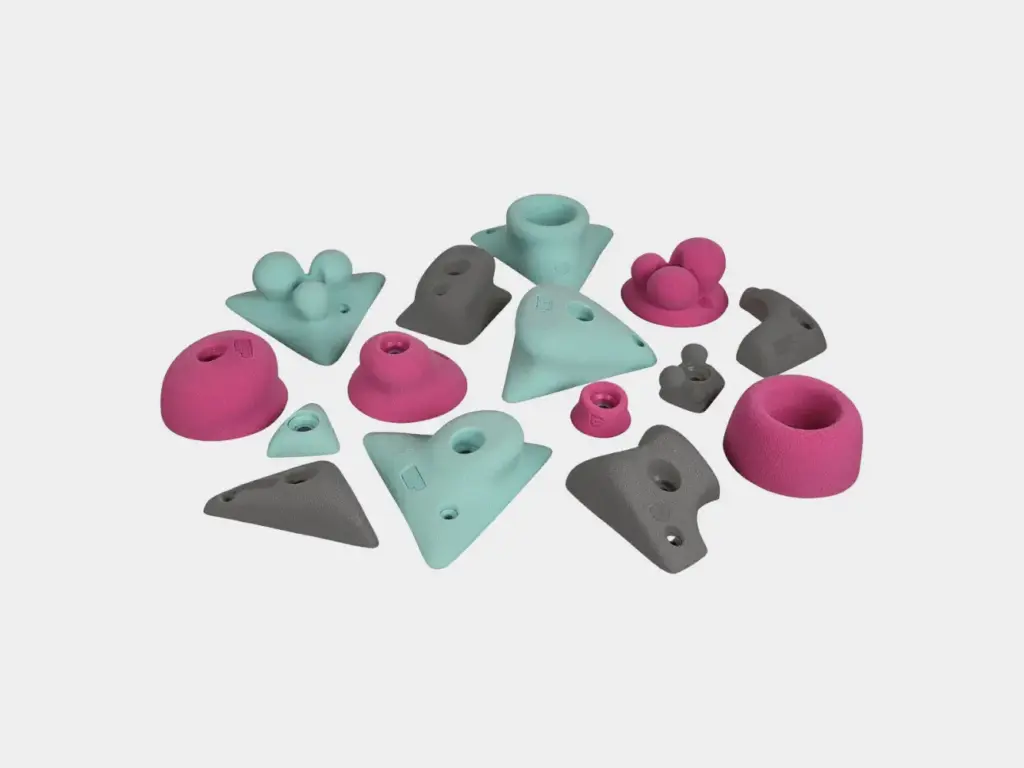
When buying components online, you will certainly come across different terms. Expressions such as “climbing grips” or “climbing rocks” are informal and technically incorrect names. No sport climber would call them that. In the climbing world, the correct terms are climbing holds and footholds, with further names depending on the type of grip and use: jugs, pinches, edges… (But perhaps more about that another time.)
When looking for inspiration or components in online shops, you can still enter these incorrect keywords into search engines because sellers of unofficial sets often use them. However, if you want top-quality holds that are ergonomic, safe for children’s joints and provide excellent friction, we recommend choosing proven brands such as Makak, Lama Holds or VirginGrip. These holds are designed to resist rotation and the materials do not release harmful substances.
In our BLOCKids online shop you will find climbing hold sets for children that fit small hands perfectly, with a surface that provides grip without scraping their fingers.
To make your final decision, go through the following characteristics.
A DIY solution is suitable for you if:
A ready-made system (BLOCKids) is suitable for you if:
Some parents try to find a compromise and search for a “used climbing wall for sale”. This is where great caution is needed. With second-hand DIY walls, you never know how they were stored (plywood kept in a damp basement loses its strength) or whether the T-nuts are rusty or damaged. If you want to save money and buy second-hand, it is better to look for used branded modular panels that retain their properties for many years.
Whichever route you choose, home bouldering will bring your children plenty of healthy movement and joy. If you are still unsure about the technical side of installation, write to us or call us – we will be happy to answer any additional questions.
1. What is the ideal panel thickness for a home climbing wall? For a safe home wall, use only high-quality birch or beech plywood with a minimum thickness of 18 mm. Thinner boards may bend under the climber’s weight and the T-nuts could pull out. Ready-made BLOCKids panels use thick, high-quality plywood with a professional surface finish.
2. Can I build a climbing wall on a drywall partition? Yes, but it requires a special approach. The structure cannot be anchored directly into the plasterboard panels; it must be anchored into the metal studs behind the drywall, or special chemical anchors or structural reinforcement must be used. In this case, we recommend consulting a professional.
3. What are “climbing rocks” and how are they different from holds? The terms “climbing rocks” or “climbing grips” are simply informal names for climbing holds and footholds, commonly used in DIY stores or non-specialist online shops. Professional information on choosing the right shapes and materials can be found, for example, on the Lama Holds blog.
4. How many climbing holds do I need per square metre of wall? For children, we normally recommend 6 to 10 holds per square metre. It is good to combine larger holds (for hands) with smaller footholds (for feet). The advantage of modular walls is the dense T-nut grid, which allows you to move the holds freely and change the difficulty of the routes.
5. How should I create a landing area under a home climbing wall? Children’s safety is the most important thing. There should never be a bare floor under the wall, even with low bouldering walls. The ideal solution is a dedicated bouldering crash pad, a high-density foam mat or certified BLOCKids impact mats that reliably absorb a potential fall.
6. How long does a home climbing wall last? If the wall is installed indoors with stable humidity and temperature, its lifespan is practically unlimited. DIY walls made from cheaper materials (such as OSB) may begin to crumble around the holds over time. Certified BLOCKids panels made from premium plywood will easily last throughout your children’s childhood.
Building a climbing wall is an investment in your children’s health and happiness, so it is important not to overlook any detail. If you have any questions about wall load capacity, suitable materials or how to configure the panels for your home, we are here to help.

Czech manufacturer of children's climbing walls, holds, and crash pads. We design and manufacture indoor climbing walls in the Czech Republic, meeting EN 1176/1177 safety standards and helping children develop motor skills, strength, and confidence — at home on a children's climbing wall, in the garden, and in kindergartens and schools. We also supply climbing holds for kids and safe crash pads for our walls. We write about what we know from experience: safe climbing for children from wall design to installation.
Design your own climbing wall exactly according to your family’s space, taste, and needs.
Get the kids involved and design a wall together according to your preferences — colors, shapes, and dimensions. Fun designing, beautiful and functional results.

Write to us – we will be happy to recommend a suitable solution and answer your questions.


