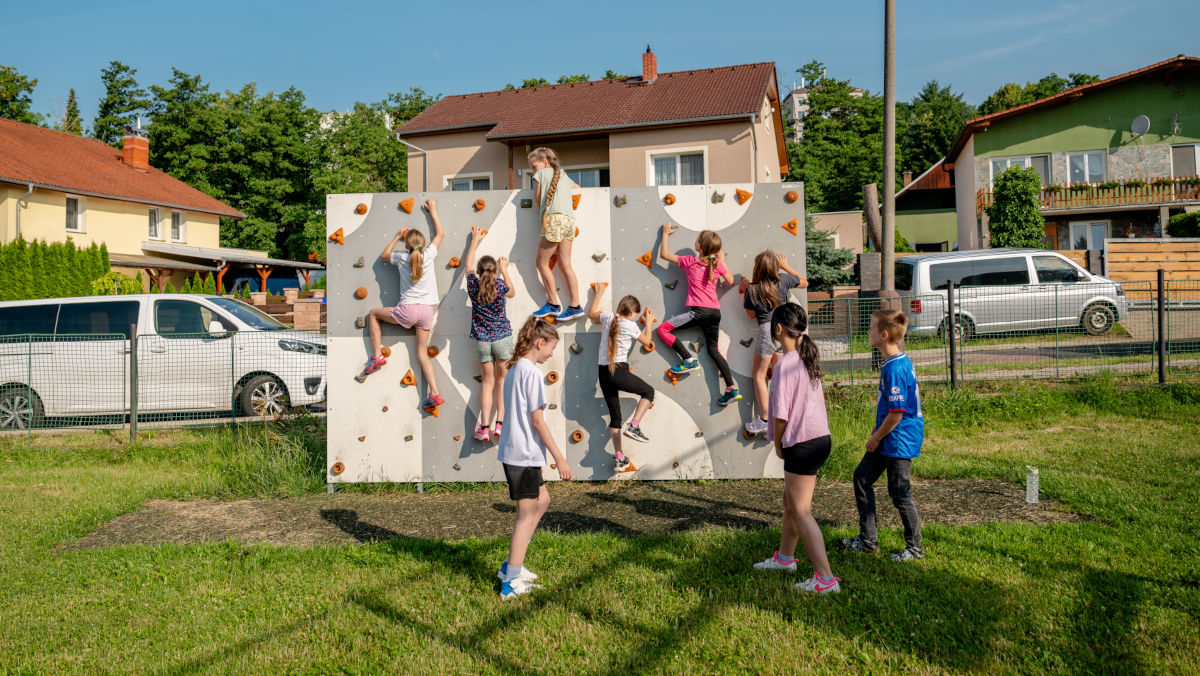
Are you planning a family celebration? Are you expecting an “invasion” of children from the neighbourhood who have not yet scattered off to summer camps or gone on holiday with their parents? Do you want to provide them with great entertainment and give yourself some peace under the pergola with a Piña Colada in your hand?
Imagine it: No long faces, no begging for screen time. Just a group of children who have fallen under the spell of movement in the fresh air. A few action-packed challenges are all it takes and the entertainment is taken care of. So that you can fully enjoy your drink, we have prepared tips for games and competitions for children on your outdoor playground. Let’s prepare a birthday party in the garden together so that it is fun and, above all, completely safe.
To keep the competition moving, combine climbing on the wall with games on the ground that test strength, balance and teamwork. It is up to you whether you let the children compete for prizes or simply for fun.
Attach scoring cards, sweets or small gifts to selected outdoor holds using double-sided paper tape. The child’s task is to climb on the wall and, within a set time limit (e.g. 30 seconds), collect as many objects as possible or record as many points as possible.
Tip: Prepare score cards on which the children can write down the number of points they have earned.
A classic that simply belongs in the garden. Divide the children into two teams (the birthday child can choose their team). Tie a coloured scarf in the middle of the rope and mark a centre line on the grass (for example with another piece of rope). The game is a great test of whole-body strength and also involves children who are not particularly fond of heights.
Mark the TOP (the finishing hold) and prepare the mats. The children form pairs and their task is to climb together to the marked hold while holding hands. This means that they mainly use their legs and one free hand each for climbing. In this way, the children practise not only the correct loading of footholds and handholds, but also their ability to cooperate.
Do you have two sturdy trees in the garden? Stretch a balance strap (slackline) or a strong rope between them, just above the ground. If you do not have them, simply place a thicker rope directly on the grass in a zigzag line. The children’s task is to get from one end to the other without losing their balance (without stepping onto the grass). To make it more difficult, the children can carry a cup of water while walking on the rope.
Prepare blindfolds and place a sufficient number of impact mats under the wall. The children again divide into pairs, with one climbing and the other navigating. The climber covers their eyes with a blindfold and their partner tells them where the footholds and handholds are. For example: left hand higher, right foot more to the left… Again, the children can measure the time it takes them to reach the marked hold. The “blind” climber can also find the route independently without anyone giving advice.
Our tip: Attach a bell to the top of the wall for the child to ring when they complete the climb.
If you have balance boards or walkways, wooden logs, seat cushions, foam blocks or a garden swing available, use them to create an obstacle course. The children must complete the route from point A to point B by stepping only on these “islands”. Every touch of the grass adds 5 seconds to the total time.
You need an inflatable paddling pool or another smaller water container and pebbles, coins or plastic tokens. Most importantly, however, you need to prepare the “vessels”. The children can make these themselves by decorating plastic plates. Each child has three vessels of their own: an aircraft carrier, a submarine and a torpedo boat.
The children stand opposite each other on opposite sides of the paddling pool (they can also play in teams) and take turns throwing “projectiles” at the vessels in the water. Each side has all three vessels in the water at the same time. The aim is to “sink” all of the opponent’s ships by hitting them several times. A ship is hit when the specified number of pebbles or tokens is lying on it: 4 on the aircraft carrier, 3 on the submarine and 2 on the boat. As soon as a vessel “sinks”, we remove it from the container. The player or team with the last ship remaining in the water wins.
Tip: Write the number of hits needed to sink each vessel on the plates to prevent possible arguments.
Garden games deserve a proper ceremonial announcement of the results. To give the celebration the right finishing touch, prepare simple certificates in advance. All you need is clean, thick paper and markers, with which you can create a stylish Garden Championship heading and then fill in the placing and name on the spot. If you do not want to disappoint anyone and want to avoid tears over a poor placing, give all children, without exception, commemorative certificates with the words Garden Championship Star + the child’s name.
You can also download a nice certificate or commemorative sheet for printing free of charge.
Quick prize tip: Instead of classic sweets, which melt easily in the sun, choose something practical. Colourful sports wristbands or wooden medals that the children can decorate themselves with markers at the end of the party work brilliantly. Combine the announcement of the results with a group photo by the wall on a winners’ podium made from garden logs.
Safety in the garden always requires attention – outdoors, children naturally lose their inhibitions and often have even more energy than at home. BLOCKids outdoor panels are made from highly durable materials (such as water-resistant birch plywood with a non-slip surface) and meet strict standards, but the safety of the game itself is in your hands.
Before the party starts, introduce three golden garden rules:
Check the impact zone: There must always be enough space under the climbing wall for a safe landing. Even during the day, check whether forgotten garden tools, sharp stones or newly brought toys are lying in the grass around the climbing wall and balance elements.
Only the “competitors” are on the wall; everyone else cheers: Only one or two children climb on the climbing wall at a time. The others form a safe fan club at a sufficient distance (for example, sitting on a blanket on the grass). This prevents accidental collisions.
An adult as the head referee (for children under 10): One parent acts throughout as the coordinator, referee and supervising person who keeps watch. (Save your drink for later. ?)
If a mixed-age group arrives at the garden party (for example younger siblings), adapt the difficulty of the activities to them:
For the youngest children (3–5 years): Help them hold the tug-of-war rope, or turn it into a “Caterpillar” game in which everyone holds the rope and makes it wave. On the climbing wall, mark out a route for them only low above the mat.
For older children (6–10 years): Add timed challenges. When balancing on the rope, you can blindfold them (they help each other walk) or ask them to cross the rope backwards. On the climbing wall, they can climb a route defined by only one specific colour of holds.
The garden offers endless possibilities. The children can burn off energy in the fresh air, test their agility, and you can be sure that they will return home pleasantly tired and full of great impressions.
The same rule applies to a home garden party as at home. It should cover the entire width of the wall and extend at least 1 metre into the area where children jump down. Grass may absorb falls less effectively, especially if it is dry and hard in summer. Therefore, consider a safer impact surface option.
BLOCKids outdoor climbing panels are made from extremely durable water-resistant plywood (with a protective coating and non-slip surface), so a little rain will not harm them. However, the holds and tug-of-war rope can become slippery. If a shower comes, move the balance games and competitions to a covered terrace or garage and return to the wall once it has dried.
Definitely yes! The magic of BLOCKids walls lies in the fact that you can easily change the position of the holds. For the party, install larger, easy-to-grip holds (so-called jugs) in the lower rows. You can then set competition disciplines such as “Spider Collector” so that children do not have to climb high but instead move more horizontally just above the mat.
For a smooth and safe event, we recommend supervising a maximum of 6 to 8 children per adult. The key is to keep the rest of the group occupied: while one child competes against the clock on the wall, the others sit on a blanket and cheer. They can also time the climb or count points. If there are more than 8 children, it is ideal for two parents to share the role of referees (one by the wall, the other at the balance games).
This is common at garden parties. The solution is to divide the children into two categories or use a fair system. Older children can be forbidden from using certain colours of holds on the climbing wall (or may climb using only one colour), while the youngest children can use any hold and a parent helps them by holding their hand while balancing on the rope. The aim is for everyone to enjoy success and a reward at the end.

Czech manufacturer of children's climbing walls, holds, and crash pads. We design and manufacture indoor climbing walls in the Czech Republic, meeting EN 1176/1177 safety standards and helping children develop motor skills, strength, and confidence — at home on a children's climbing wall, in the garden, and in kindergartens and schools. We also supply climbing holds for kids and safe crash pads for our walls. We write about what we know from experience: safe climbing for children from wall design to installation.
Design your own climbing wall exactly according to your family’s space, taste, and needs.
Get the kids involved and design a wall together according to your preferences — colors, shapes, and dimensions. Fun designing, beautiful and functional results.

Write to us – we will be happy to recommend a suitable solution and answer your questions.


