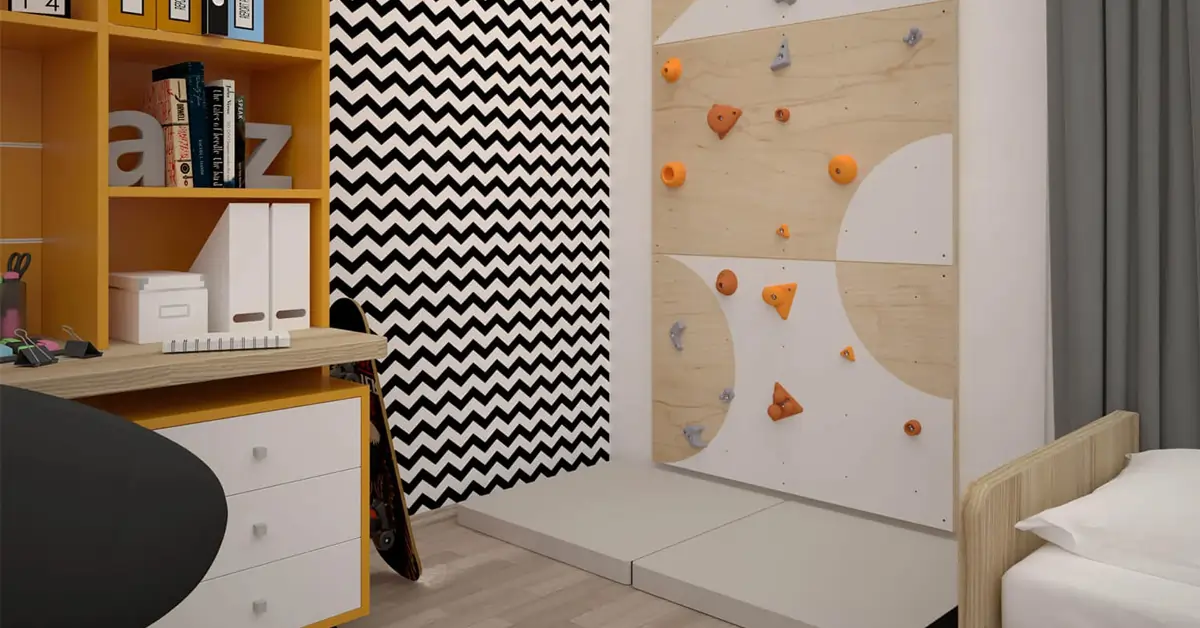
The Olympic Games introduced sport climbing to millions of families around the world. But climbing is no longer just for professional athletes — it has become a fun, healthy, and inspiring activity for kids of all ages.
A well-designed Kids Climbing Wall supports movement, coordination, confidence and active play directly at home.
In this guide, we will show you:
Ready? Let’s climb in.
There are many climbing wall manufacturers on the market, and every system looks slightly different. Colourful climbing holds may catch the eye first ?, but the key factors are safety, durability and flexibility.
The climbing panels are the foundation of the entire wall.
For indoor climbing walls, we recommend:
with a minimum thickness of 15–18 mm for reliable strength and durability.
OSB panels can also work for DIY projects, but they generally have a shorter lifespan and lower resistance to repeated dynamic loads.
A high-quality climbing wall should feel stable, rigid and safe even during energetic climbing sessions.
Indoor climbing walls do not need heavy outdoor weather protection, but the surface finish still plays an important role.
A good climbing panel should:
Many professional climbing panels use special coatings with fine-textured surfaces to improve grip without being abrasive.
Just as important:
Children climb differently from adults, so climbing holds should be designed specifically for smaller hands.
Good children’s climbing holds:
Different hold colours can also help create simple climbing routes with different difficulty levels.
Older children often enjoy following colour-based routes, while younger children simply explore movement freely.
A properly designed Indoor Climbing Wall grows together with the child’s abilities.
Many parents imagine that a climbing wall requires a huge room. In reality, even a compact wall can fit into:
For preschool children, a climbing area from around 2 m² can already provide plenty of movement opportunities.
A wall height of up to approximately 2.5 metres is generally ideal for home use. Even when children climb to the top, their feet remain significantly lower, making controlled descents easier. Higher ceilings are possible, but they require more careful planning and additional safety measures.
One climbing panel is enough to start. Two or more panels allow horizontal movement (traversing), which is excellent for coordination and motor skill development.
A climbing wall can become both a functional activity zone and a beautiful design feature — but its placement matters.
Do not install the wall next to doors that open into the climbing area. A child climbing near an opening door creates unnecessary risk.
Maintain at least 1.5 metres of free space around the landing area whenever possible. Beds, desks or sharp furniture corners should stay outside the fall zone.
Side or overhead lighting usually works best. Strong lighting from below can create shadows and make the climbing holds harder to judge.
When children fall, the most important factor is not only the height — but the landing surface. Soft blankets, pillows or regular mattresses are not designed to absorb climbing impacts safely.
A proper climbing mat should:
Professional impact mats designed for children’s climbing walls are tested according to European safety standards. The BLOCKids Impact Mats are designed specifically for children’s indoor climbing environments and comply with EN 1176 and EN 1177 safety requirements.
Children grow quickly — and so do their climbing skills. That is why modular climbing systems are often the smartest long-term investment.
Choose panels with:
This allows you to:
A good rule of thumb is that the panel should have at least twice as many mounting holes as installed climbing holds.
Not sure whether your child will love climbing?
Start small.
Many families begin with one or two panels and later expand the wall upward or sideways as enthusiasm grows.
More is not always better.
Walls overloaded with holds can confuse children and reduce movement creativity. Slightly more challenging spacing often improves balance and problem-solving skills.
Climbing walls create significant leverage forces and must be anchored securely into structural walls. Drywall installations require specialised fixing systems and professional advice. Proper installation is essential for safety.
Many children prefer jumping down immediately, but controlled climbing down is an important skill.
Descending carefully improves:
That said — occasional jumping is still part of the fun ?.
If possible, involve your child in building or setting up the climbing wall.
Understanding how climbing routes work often increases confidence and motivation. Children love participating in the creation of their own play space — and it helps build a stronger relationship with movement and climbing from the very beginning.
What size climbing wall is best for a child’s bedroom?
For most families, a compact modular wall is the best starting point. Even a small setup with 2–4 panels can provide excellent movement opportunities.
Where should a climbing wall never be installed?
Avoid placing the wall next to doors, sharp furniture edges or narrow passageways. The landing zone should remain open and unobstructed.
What type of mat should I use under the wall?
Use a professional climbing mat or impact mat designed for climbing falls. The mat should extend beyond the wall area and provide reliable shock absorption.
Can a climbing wall be installed on drywall?
Yes, but drywall installations require specialised anchors and proper structural support. Professional consultation is highly recommended.
Are modular climbing walls worth it?
Absolutely. Modular systems allow you to expand, redesign and adapt the wall as children grow and improve their climbing skills.

Czech manufacturer of children's climbing walls, holds, and crash pads. We design and manufacture indoor climbing walls in the Czech Republic, meeting EN 1176/1177 safety standards and helping children develop motor skills, strength, and confidence — at home on a children's climbing wall, in the garden, and in kindergartens and schools. We also supply climbing holds for kids and safe crash pads for our walls. We write about what we know from experience: safe climbing for children from wall design to installation.
Design your own climbing wall exactly according to your family’s space, taste, and needs.
Get the kids involved and design a wall together according to your preferences — colors, shapes, and dimensions. Fun designing, beautiful and functional results.

Write to us – we will be happy to recommend a suitable solution and answer your questions.


