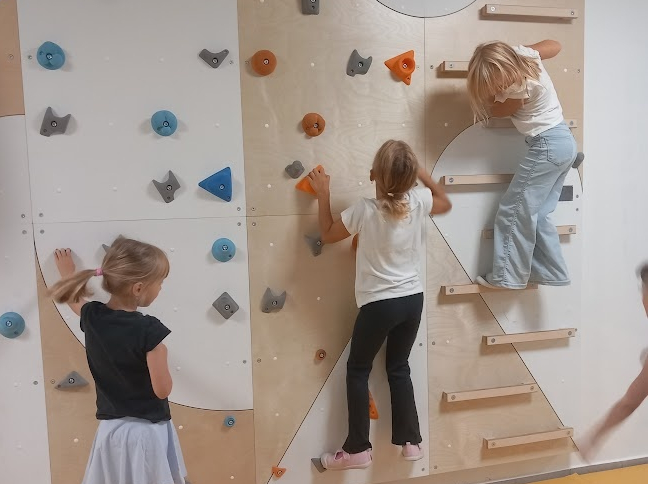
Supporting natural movement, developing gross motor skills and building healthy self-confidence. These are the main reasons why climbing walls are becoming an increasingly popular feature in modern kindergartens and childcare facilities.
Whether you are planning to enhance a gym, playroom, corridor or kindergarten garden, as a director or operator you are responsible not only for the educational side of the project, but above all for safety and the necessary administration. This naturally raises some important questions: Which standards do we need to meet? How do we provide the right impact area? How can we finance the project and how should inspections be handled?
Our guide takes you through the process step by step, showing what you need to arrange before purchasing and what you can safely leave to us, so that the entire project runs smoothly, without unnecessary stress and, most importantly, to the delight of the children.
Let us start with the regulatory framework. As the operator of a school or childcare facility, you are responsible for the safety of the children.
In addition to the climbing wall itself, the standards also address the surrounding area. We distinguish between two basic concepts:
Practical tip for kindergartens: We most commonly supply climbing walls up to 2.5 m high for kindergartens. It is better to extend the climbing area sideways and teach children to traverse – climbing sideways close to the ground. For the youngest children this is the safest option and it also reduces the requirements for the thickness of the impact surface. Certified mats with hook-and-loop connections are ideal indoors; for outdoor playgrounds, poured rubber surfacing or rubber safety tiles are suitable options.

Before ordering, you need to assess the technical possibilities of the building:

An investment in a climbing wall does not necessarily have to come entirely from your regular operating budget. There are other options worth considering:
Building a climbing wall yourself in a kindergarten environment can create both legal and safety risks. By choosing our professional turnkey installation, you can leave the technical responsibility for the installation to us.
What our complete installation includes:
Would you like safe climbing in your kindergarten without unnecessary administrative worries?
Take a look at our climbing wall solutions for schools and institutions or contact us directly for a no-obligation consultation and a quotation tailored to your project.
1. Which standard applies to climbing walls in kindergartens?
For kindergartens, childcare facilities and school environments, EN 1176 applies to playground equipment and EN 1177 to impact-attenuating surfacing. The specific legal and inspection requirements can vary by country, so the local regulations should always be checked as well.
2. How high should a climbing wall in a kindergarten be?
For preschool children, a wall height of up to 2.5 m is ideal. The focus does not need to be on climbing upwards – traversing, or climbing sideways, provides excellent motor development while keeping children closer to the ground.
3. Can the wall be installed on a plasterboard partition in the gym?
Installation on plasterboard is usually possible. For professional installations, our technicians use special fixings designed for this type of wall construction.
4. What documents does a director need for a safety inspection?
For an inspection, you should have the relevant EN 1176 conformity/certification documents from an accredited testing body, operating instructions, maintenance instructions and the installation record from the manufacturer or supplier.
5. How should a climbing wall in a kindergarten be maintained and inspected?
In line with EN 1176, routine visual inspections should be carried out regularly, operational inspections are typically performed every 1–3 months (including checking the holds and impact mats), and a main inspection is carried out once a year by a competent person.

Czech manufacturer of children's climbing walls, holds, and crash pads. We design and manufacture indoor climbing walls in the Czech Republic, meeting EN 1176/1177 safety standards and helping children develop motor skills, strength, and confidence — at home on a children's climbing wall, in the garden, and in kindergartens and schools. We also supply climbing holds for kids and safe crash pads for our walls. We write about what we know from experience: safe climbing for children from wall design to installation.
Design your own climbing wall exactly according to your family’s space, taste, and needs.
Get the kids involved and design a wall together according to your preferences — colors, shapes, and dimensions. Fun designing, beautiful and functional results.

Write to us – we will be happy to recommend a suitable solution and answer your questions.


